Tankless Water Heater Error Codes: What They Mean
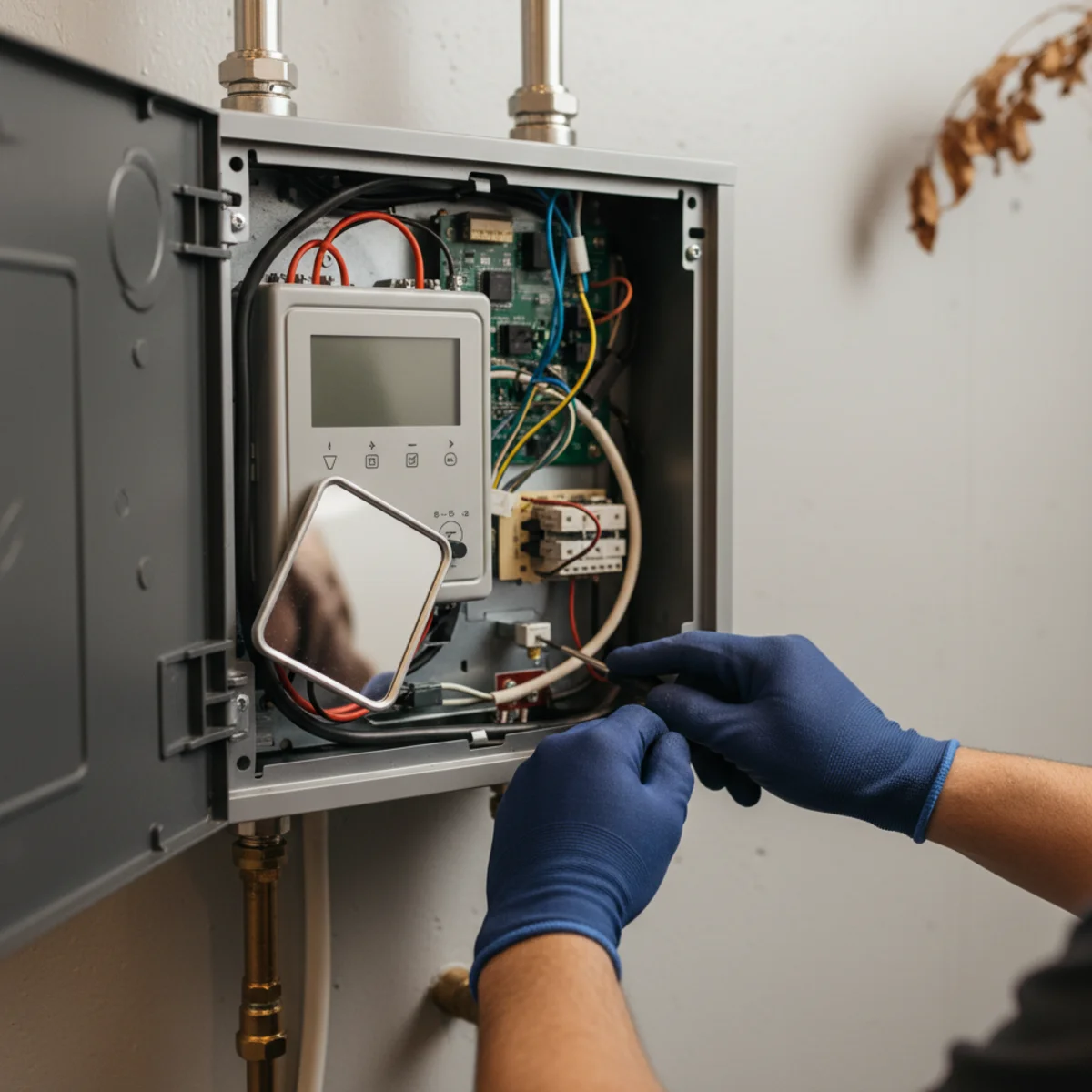
Your tankless water heater has gone cold and the display is showing a code you've never seen before. The good news is that error codes are the unit trying to tell you exactly what's wrong — they narrow the diagnostic work considerably. The frustrating part is that codes are brand-specific: a "12" on a Rinnai means something entirely different from a "12" on a Navien or a Noritz. That said, most codes fall into a small number of common failure categories, and understanding those categories helps you know whether to reset and wait, adjust something minor, or call a plumber.
Always Check the Manual First
Before assuming the worst, look up your exact code in the unit's manual. Most manufacturers post current manuals and error code charts on their websites. The unit's model and serial number are on a label inside the front panel or on the side of the unit. Write those down — you'll need them if you call for service.
Some codes are informational (maintenance reminders, service interval alerts) and do not indicate an active failure. Others require immediate attention. Your manual will tell you which is which for your specific model.
Common Categories of Tankless Error Codes
Regardless of brand, most tankless error codes fall into one of these general categories:
- Ignition failure: The unit tried to fire the burner and failed, usually after three attempts. Common on gas units. Causes include low gas pressure, a faulty igniter, a dirty flame sensor, a blocked exhaust, or (on outdoor units) strong winds interfering with combustion. These codes are often displayed as "ignition error," "no ignition," or a code in the 10-16 range on many brands.
- Flame failure / flame loss: The burner lit but lost flame during operation. Similar causes to ignition failure — often a dirty flame rod or combustion air issue. Do not confuse this with a gas supply issue unless other gas appliances are also affected.
- Overheat / high temperature: The heat exchanger or outgoing water exceeded a safety threshold. Common causes include scale buildup on the heat exchanger (hard water, again), a restricted flow rate through the unit, or a faulty thermistor. In Lebanon County, this code tends to appear more frequently on units that haven't been descaled.
- Exhaust or venting problem: Blocked or restricted venting (birds' nests, debris, collapsed flex duct) triggers codes on many units. These are safety codes — a unit with blocked exhaust can back-draft carbon monoxide into the living space. Do not operate the unit until venting is cleared.
- Water flow or pressure issues: The unit requires a minimum flow rate to fire. Low flow codes occur when a partially closed valve, a clogged inlet filter, or very low municipal pressure fails to meet that minimum. Check that the cold-water inlet valve to the unit is fully open and clean the inlet filter screen.
- Thermistor or sensor failure: Temperature sensors (thermistors) on the inlet, outlet, or heat exchanger can fail. These codes usually require part replacement.
- Scale / maintenance codes: Many units track operating hours and display a maintenance reminder at set intervals. These are not emergency codes, but they are genuine prompts — descaling and flushing are due.
What You Can Try Before Calling
Some codes clear on their own once the triggering condition resolves. A power cycle (turn the unit off, wait 30 seconds, turn back on) clears many transient fault codes. Beyond that:
- Check that the cold-water inlet valve is fully open.
- Remove and rinse the inlet filter screen — it collects debris over time.
- Inspect the venting termination outside the house for obvious blockages.
- Confirm other gas appliances are working if the code suggests ignition or combustion problems.
If the code returns after a power cycle, the underlying condition has not resolved. That is when a service call is warranted.
Hard Water and Scale: The Biggest Tankless Problem in Central PA
Lebanon County's hard water is especially punishing to tankless units because the heat exchanger operates at higher temperatures than a tank, and scale forms faster under heat. A scaled heat exchanger triggers overheat codes, forces the unit to work harder to reach set temperature, reduces flow capacity, and can eventually cause the heat exchanger to crack — an expensive failure.
Annual descaling (flushing the heat exchanger with a food-grade descaling solution) is not optional in this region; it is standard maintenance. Our tankless water heater service team brings a descaling kit and can clear most scale codes in a single visit.
When the Code Points to a Serious Repair
Some codes indicate component failures that require parts: a faulty gas valve, a failed circuit board, a cracked heat exchanger, or a burned igniter. These are not DIY repairs — gas components in particular require a licensed and insured technician. On older units approaching 15 to 20 years, a major component failure can tip the cost-benefit analysis toward replacement.
Our water heater maintenance service includes a full system check on tankless units — burner condition, heat exchanger, venting integrity, and water filter — and we give you an honest read on whether repair or replacement makes better financial sense. Upfront pricing before any work begins.
Book a Same-Day Diagnostic
An error code means the unit has already done half the diagnostic work for you. Bring us the code, the brand, and the model number, and we can often confirm the repair before we arrive. Call (201) 277-9344 or schedule online via our tankless water heater page. We serve Lebanon, Jonestown, Fredericksburg, and the surrounding Lebanon County area.
Related water heater services
Written by the team at Lebanon Water Heater Pros. This article is general information for Lebanon-area homeowners, not a substitute for an on-site diagnosis. For suspected gas leaks, leave the home and call your gas utility or 911 — do not attempt gas repairs yourself.
Good questions
Frequently Asked Questions
Keep reading
Related articles
Tankless vs. Tank Water Heater: Which Is Right for You?
Tankless water heaters offer endless hot water and longer lifespan, but tank units cost less upfront and work well for most households. Here's how to choose for a Lebanon, PA home.
7 min read
When to Upgrade to a Tankless Water Heater
Tankless water heaters deliver real advantages in the right situation. The key is knowing whether your home and habits match those situations — or whether a good conventional tank is the smarter call.
6 min read