Electric Water Heater Not Heating? Check Elements & Thermostats
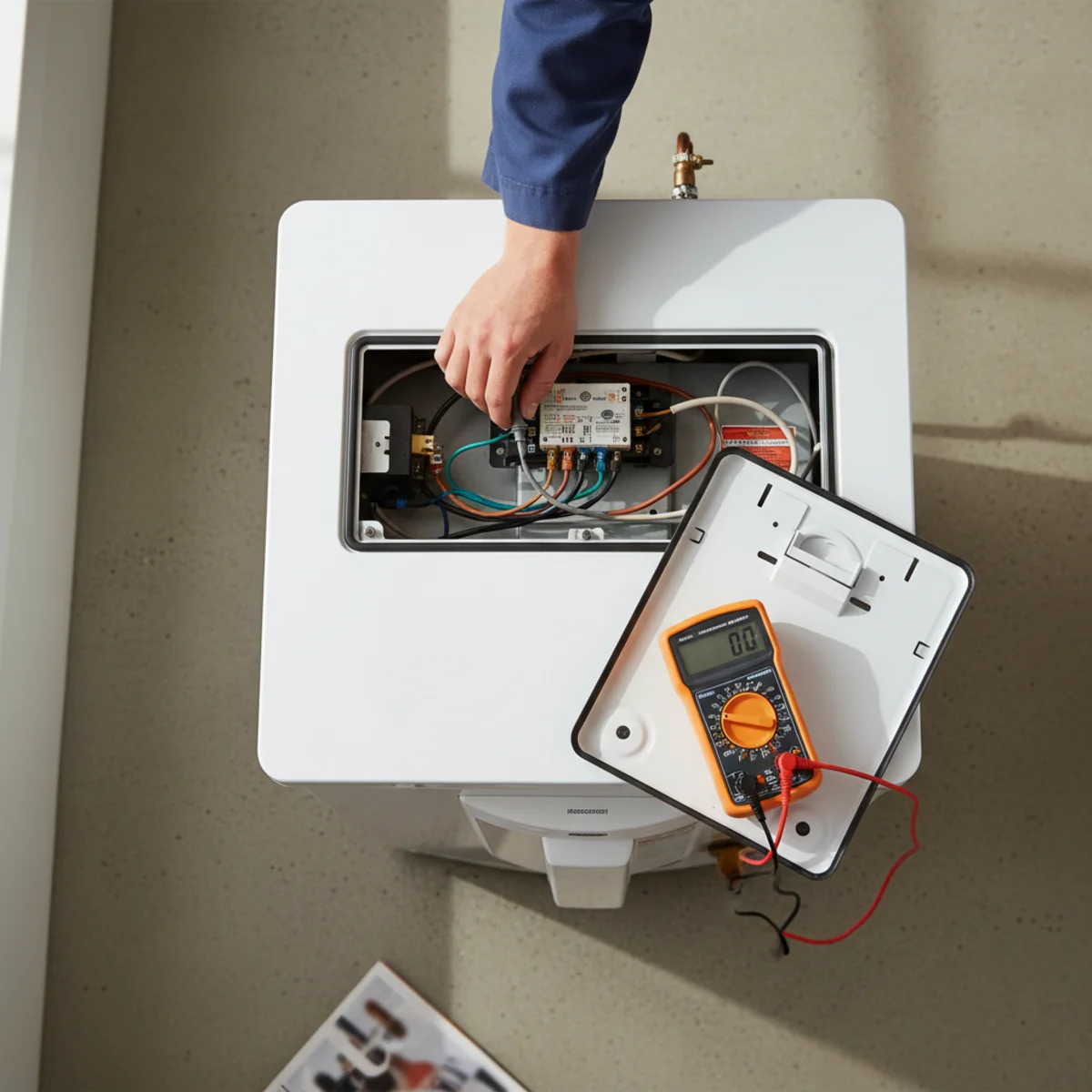
You turn on the hot tap and what comes out is lukewarm at best, cold at worst. The electric water heater in the basement is silent — no hum, no heat, no indication it's doing anything at all. Before you start pricing replacements, know that most electric water heater failures are component failures, not whole-unit failures. The right diagnosis can save you the cost of a new tank.
Start Here: The High-Limit Reset Button
Most electric water heaters have a red reset button on the upper thermostat, behind the top access panel. It's a high-limit safety cutout — if the water gets dangerously hot, the button trips and shuts off both elements. A tripped reset doesn't always mean something catastrophic happened. Sometimes a power surge, a momentary thermostat malfunction, or sediment overheating the lower element is enough to trip it.
Pop off the upper access panel (the power should be off at the breaker first), push the red button until you feel or hear it click, replace the panel, and restore power. Give the tank 60 to 90 minutes and check for hot water. If the reset trips again immediately or within a day, there is an underlying problem driving the high temperature — a failed thermostat stuck in the "on" position is the most common cause. Do not keep resetting it without investigating further.
How a Two-Element Electric Water Heater Works
Standard electric tanks use two elements — upper and lower — each with its own thermostat. They do not run simultaneously. The upper element heats first; once the upper portion of the tank reaches the set temperature, the upper thermostat hands off to the lower element to heat the bottom portion. If the upper element or thermostat fails, you get no hot water at all. If only the lower element fails, you get a small amount of hot water that runs out faster than usual.
Understanding this helps narrow the problem quickly. Completely cold water almost always points to the upper element or its thermostat. Water that runs out after just a few minutes suggests the lower element is cooked.
Signs of a Failed Heating Element
Elements burn out for a few reasons: age, normal wear, or scale buildup from hard water. In Lebanon County, hard water sediment is a significant factor — scale insulates the element, causing it to overheat and eventually fail. An element can also short internally, causing the breaker to trip rather than just leaving you cold.
- Completely cold water: Upper element failure or tripped reset.
- Water warms slightly but never gets hot: Lower element may be partially functional or scale-coated.
- Breaker trips repeatedly: Element has shorted to ground — needs immediate replacement.
- Visible corrosion or cracks on the element flange: Element is done regardless of electrical function.
Testing an element properly requires a multimeter and knowledge of what a correct resistance reading looks like for your element's wattage. It is not complicated, but it does require the power to be off at the breaker and all wiring disconnected from the element before testing. Skipping either step is a serious safety risk.
Thermostat Failure on Electric Water Heaters
Electric water heater thermostats are flat, spring-loaded devices that press against the tank wall to sense water temperature. They can fail in two ways: open (no longer calling for heat, so the element never comes on) or closed (stuck calling for heat, so the element runs continuously until the high-limit trips). Both patterns are bad.
A thermostat stuck closed is the more dangerous failure — it drives water temperature dangerously high and will trip the high-limit reset repeatedly. If the reset keeps popping, suspect the thermostat. A thermostat that has failed open simply leaves the element cold even when it should be running.
Replacing a thermostat is straightforward but requires the power to be fully off and the wiring diagram on the unit to be followed precisely. Misconnecting thermostat wiring can cause the elements to run simultaneously, which will trip the breaker.
When Hard Water Is the Real Problem
If your electric water heater keeps losing elements — second or third replacement in a few years — the root cause is usually scale from hard water. The solution isn't just swapping elements indefinitely. It means addressing the sediment: professional electric water heater service can flush the tank, check the anode rod, and install a higher-quality element that handles scale better. In severely scaled tanks, a full replacement may be more cost-effective than ongoing element swaps.
If you have not had your water heater flushed in the past couple of years, sediment is almost certainly a contributing factor to any heating problem you are experiencing.
Checking the Breaker
Before anything else, confirm the breaker hasn't tripped. Electric water heaters typically run on a dedicated 240-volt double-pole breaker. A tripped 240V breaker often sits in a middle position between "on" and "off" — it may not look fully tripped. Push it firmly to "off" first, then back to "on." If it trips again when you restore power, there is a short in the circuit — element, wiring, or thermostat — that needs to be tracked down before the tank will work safely.
Get a Professional Diagnosis
Element and thermostat testing on a live 240-volt circuit is not a task to rush through without experience. Our water heater repair crew carries standard replacement elements and thermostats on the truck and can run proper electrical tests to confirm the exact failed component before ordering anything. Upfront pricing before any work begins, same-day service available in Lebanon County.
Call (201) 277-9344 or schedule online. A diagnostic visit is far less expensive than replacing a tank that only needs a forty-dollar element.
Related water heater services
Written by the team at Lebanon Water Heater Pros. This article is general information for Lebanon-area homeowners, not a substitute for an on-site diagnosis. For suspected gas leaks, leave the home and call your gas utility or 911 — do not attempt gas repairs yourself.
Good questions
Frequently Asked Questions
Keep reading
Related articles
No Hot Water? A Step-by-Step Troubleshooting Guide
No hot water is one of the most frustrating household problems—but it has a short list of causes. Work through this guide to find yours and know what to do next.
7 min read
7 Signs Your Water Heater Is Going Bad
Catching the signs your water heater is going bad early is the difference between a planned replacement and a flooded utility room. These 7 warning signs are worth knowing.
7 min read